

Oracle 1Z0-1066-26 Daily Practice Exam New 2026 Updated 141 Questions
Use Valid 1Z0-1066-26 Exam - Actual Exam Question & Answer
NEW QUESTION # 49
Which two statements are true when using Measure catalogs? (Choose two.)
- A. You navigate to Configure Measure Catalogs to edit the Catalog.
- B. The measure catalog has a collection of measures that you can enable for use in a single plan in the Planning Central work area.
- C. The predefined measure catalog is not the system default.
- D. Measure catalogs are defined in the system to improve the performance of the plan.
- E. You can add or remove measures from a measure catalog.
- F. You can restrict access to Measure Catalogs using Administer Data Security.
Answer: B,E
NEW QUESTION # 50
You ran a demand plan and you are reviewing the shipments forecast value measure. It is always zero for a particular item. Identify the root cause of this problem.
- A. In planning measures catalog, shipment forecast measure is not enabled at item and organization level.
- B. In plan parameters, shipment forecast value measure expression is not defined.
- C. In plan parameters, Item List Price marked as primary does not have price defined for the particular item.
- D. In planning measures catalog, shipment forecast value measure is not enabled at item and organization level.
Answer: D
NEW QUESTION # 51
The five pre-configured review stages of a Sales and Operations Planning process are Product Review, Demand Review, Supply Review, Financial Review, and Executive Review.
If Product Review is NOT an integral part of your company's S&OP process, how do you configure the system to ignore it?
- A. In Manage Planning Cycles, do not add any participants or tasks for the Product Review stage.
- B. In Manage Planning Cycles, right-click the Product Review tab. and select Delete.
- C. It is not possible to ignore any of the 5 pre-configured review stages.
- D. In Manage Planning Cycles, go to the Actions menu, select Configure Stages, and set Enabled for Product Review to No.
Answer: D
NEW QUESTION # 52
Which set of transaction types data are uploaded in Contract Manufacturing Collaboration?
- A. Component Material Issues, Work-order Completions
- B. Component Material Issues, Work-order Completions, Shipment Confirmations
- C. Work-order Completions
- D. Planned orders, Planned Order Commits
Answer: A
NEW QUESTION # 53
During the FIFO pegging process, what is the correct order in which the supplies are sorted?
- A. Pegging process does not respect reservation, and demands are sorted based on demand and supply types
- B. Peg unreserved demands first and then demands with reservations
- C. Peg demands with reservations first and then peg demands that do not have reservations
- D. Pegging process sorts demands by due dates followed by reservation status
- E. Pegging process does not respect reservation, and demands are sorted based on due dates
Answer: C
NEW QUESTION # 54
On the plan page layout that you created, you have several graphs showing the status of the plans and the business. You see a concern in an area and you want to see the data behind it. What navigation should you use to see this data?
- A. You cannot see it on the plan outputs, so you need to go into Planning Analytics and re-search the data.
- B. On the table in question, go to View > Show table.
- C. You cannot see it on the plan outputs, and you will need to create a new table with the information.
- D. Go to Actions > View Data on the graph in question.
- E. You cannot see it from the plan landing page, and you will need to search for the data.
Answer: E
NEW QUESTION # 55
Planner 1 works in Europe and needs to see three measures in kilograms (the default UOM). Planner 2 is US-based and needs to see those same three measures in pounds. Both planners need to use five tables in their plan analyses on a regular basis. At the moment, all five tables are displayed in kilograms.
Which two options would most efficiently address this requirement?
- A. Open each table and format measures to duplicate the three measures and then format the duplicated measures to be displayed in pounds.
- B. Duplicate all five tables, then format the three measures in the copied tables to be displayed in pounds.
- C. Create duplicates of the three measures in Manage Planning Measures and change each new measure's UOM from kilograms to pounds, then duplicate the five tables but use the new measures.
- D. Planner 2 opens a table, formats each measure to be displayed in pounds. When Planner 1 opens the same table, they reformat back to be displayed in kilograms.
- E. There is no efficient solution to this requirement.
Answer: A,C
Explanation:
The most efficient way to accommodate both planners' needs is to create duplicates of the required measures in pounds and then duplicate the tables to include the reformatted measures. This allows both planners to access tables in their preferred units without repetitive reformatting
MY ORACLE SUPPORT
.
NEW QUESTION # 56
The structure of the Plan Summary Layout is a predefined __________.
- A. Set of Infotiles
- B. Material Plan view
- C. Group of Reports
- D. Set of Exceptions
- E. Supply Demand Workbench
Answer: A
Explanation:
In Oracle Planning and Collaboration Cloud, the Plan Summary Layout serves as a predefined set of infotiles. These infotiles are customizable and provide users with a visual summary of critical planning metrics, such as supply, demand, exceptions, and resource utilization. The purpose of these infotiles is to give planners an at-a-glance overview of key performance indicators (KPIs) within the planning process, allowing them to quickly assess areas that may need attention or adjustment.
The Plan Summary Layout is an integral part of the Planning Central feature, which enables the display of aggregated data in an organized format. This helps to streamline decision-making by summarizing complex data in a visually intuitive manner. Each infotile can be further drilled down to display more detailed information, supporting planners in making informed decisions based on comprehensive data.
Referencing official Oracle documentation, the Plan Summary Layout and its associated infotiles are fundamental components of the Planning Central module in Oracle Planning and Collaboration Cloud, facilitating efficient planning and collaboration across supply chain processes.
NEW QUESTION # 57
Which KPIs are available to measure forecasting accuracy and specify how these measures aggregated from item-organization level to higher levels.
- A. MAPE, MFE, and Bias are used to measure forecast accuracy. MAPE and MFE are aggregated using weighted average. Bias is aggregated using sum.
- B. MAPE, MAD, and Bias are used to measure forecast accuracy. MAD and Bias are aggregated using sum. MAPE is aggregated using weighted average.
- C. MAPE, MAD, and Bias are used to measure forecast accuracy. MAPE and Bias are aggregated using weighted average. MAD is aggregated using sum.
- D. MAPE, MFE, and Bias are used to measure forecast accuracy. MAPE and Bias are aggregated using weighted average. MFE is aggregated using sum.
Answer: B
NEW QUESTION # 58
Your clients want to simulate how canceling demand may impact a plan. Which two steps must be done to simulate this change? (Choose two.)
- A. Run plan with 'Do not refresh with current data'
- B. Manage Plans > Edit Plan Options > Add simulation set
- C. Open plan > View Supplies and Demands > Remove the sales order from the plan and firm demand > Save changes
- D. Run plan with 'Refresh with current data'
- E. Open plan > View Supplies and Demands > Firm the demand and set firm quantity to 0 > Save changes
Answer: A,E
NEW QUESTION # 59
You are setting up the plan page layout for your customer.
In which of these requirements would you use an Infotile?
- A. Showing customer demand trend over a specific time period
- B. Showing a breakdown of exception in a pie chart
- C. Showing inventory values by product category
- D. Showing on-hand value compared to targets
- E. Showing inventory value across time
Answer: E
NEW QUESTION # 60
What is one method of associating a Safety Stock Quantity value to an item?
- A. Enter your value in the Safety Stock Quantity column in the Items page.
- B. Enter your value in the Safety Stock Quantity Override column in the Items page.
- C. Upload the value using File Based Data Import (FBDI)
- D. Run the Safety Stock Quantity Update Process.
Answer: A
NEW QUESTION # 61
Demand planner opens the pre-seeded plan summary of the demand plan and wants to analyze the forecast results. Describe the steps to review and analyze the forecast results.
- A. Click "Revenue and Margin" tile. Review the "Revenue by Period" graph and pick a specific period. Right-click on a period, click Drill To -> Default Group -> Revenue Analysis to open the table and review the details.
- B. Click "Forecast Comparison in the thousands" tile. Review "Forecast Comparison by Product Category" graph and pick a product category. Right-click on product category, click Drill To -> Default Group -> Forecast Analysis to open the table and review the details.
- C. Click "Demand at Risk in thousands" tile. Review "Demand at Risk by Product Category" graph and pick a product category. Right-click on product category, click Drill To -> Default Group -> Demand Analysis to open the table and review the details.
- D. Click "Revenue and Forecast" tile. Review "Revenue by Period" graph and pick a specific period. Right-click on a period, click Drill To -> Default Group -> Forecast Analysis to open the table and review the details.
Answer: B
NEW QUESTION # 62
Cost accounting captures costed transactions that are picked up by the cost processor. Which is not picked up by the cost processor?
- A. period close adjusting journal entries for Payroll
- B. shipping, receiving, and inventory transactions from manufacturing
- C. invoices and revenue interfaced from Cloud Receivables
- D. supplier invoices interfaced from Cloud Payables
Answer: C
NEW QUESTION # 63
You ran a demand plan with the data refresh option "Do not refresh with current data." Identify two true statements. (Choose two.)
- A. Forecasting engine will run without advancing the plan date.
- B. Shipments history data will not be modified.
- C. Shipments history data will be updated.
- D. Shipments forecast data will not be modified.
- E. Forecasting engine will not run.
Answer: A,B
NEW QUESTION # 64
You want to check how many items have excess inventory. Which three choices will get you there? (Choose three.)
- A. Open Table, Graph, or Tile Set > Table: Exceptions > Expand Supply Planning Exceptions > Select Items with Excess Inventory
- B. Open Table, Graph, or Tile Set > Table: Items with Exceptions > Filter by Items with Excess Inventory
- C. Manage Plans > Edit Plan Options > Select Supply tab > Navigate to Item area > Filter by Items with Excess Inventory
- D. Open Table, Graph, or Tile Set > Table: Item Exceptions Summary > Filter by Items with Excess Inventory
- E. Open Table, Graph, Tile Set > Table: Items > Select any Item > Drill to: Item Exceptions > Expand Supply Planning Exceptions > Select Items with Excess Inventory > Refresh the search results
Answer: A,C,E
Explanation: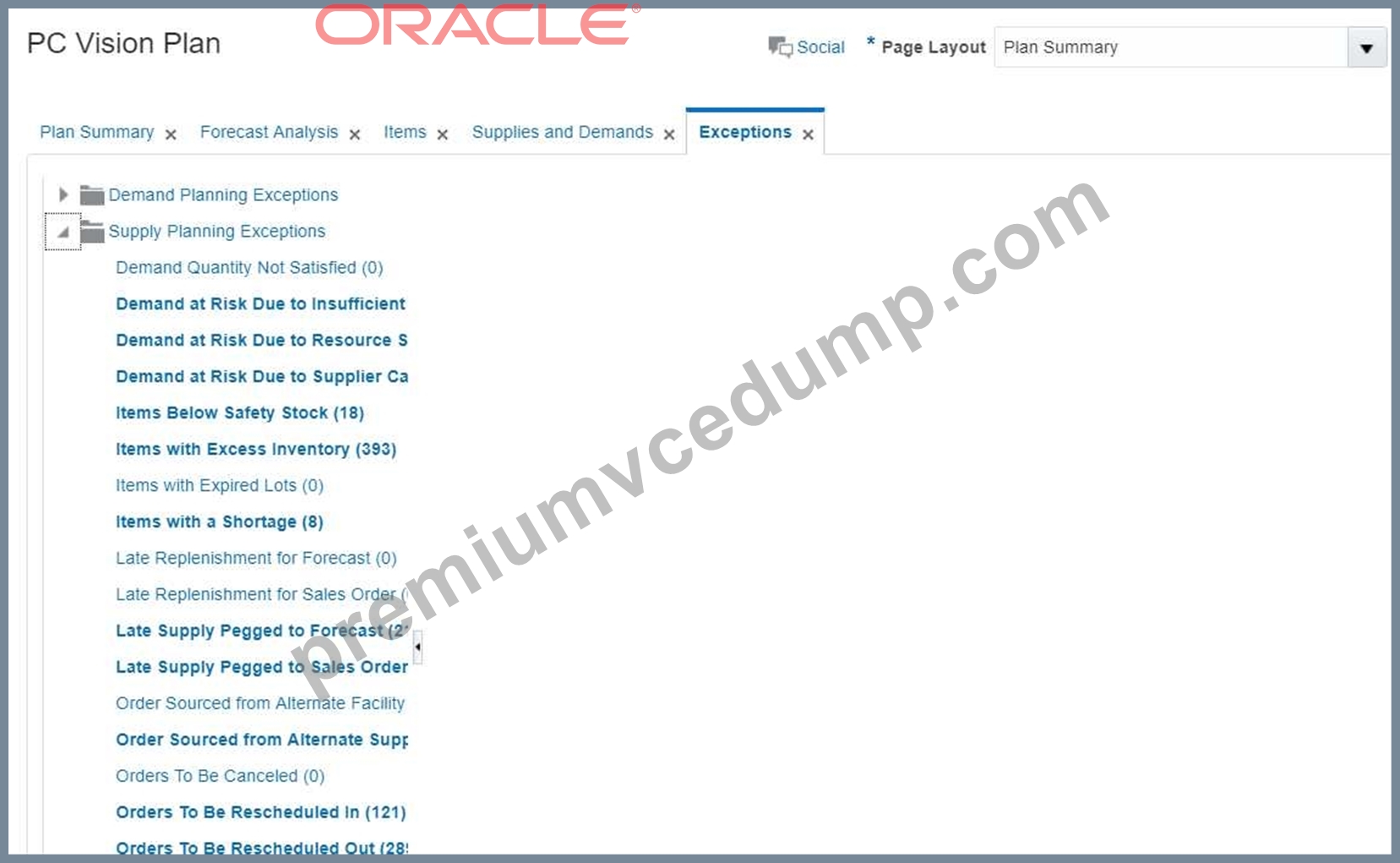
NEW QUESTION # 65
Should value in Adjusted Shipments Forecast measure always be equal to the Final Shipments Forecast measure?
- A. Yes,if the demand plan hasn't been run again after adjustment.
- B. Yes, if the adjustment is made below the aggregation level at which it is viewed.
- C. Yes,if the demand plan is approved and values are locked.
- D. No, both measures will always be different.
- E. Yes,if the adjustment is made at the same aggregation level at which itis viewed, or below.
Answer: E
NEW QUESTION # 66
......
Test Engine to Practice 1Z0-1066-26 Test Questions: https://pass4lead.premiumvcedump.com/Oracle/valid-1Z0-1066-26-premium-vce-exam-dumps.html